
Click here to browse our On The Mend Portfolio!
Anterior cruciate ligament reconstruction depends on stable graft fixation while bone tunnels heal. The Peek Interference Screw is one option: it compresses the graft against the tunnel wall, creating immediate mechanical fixation. Polyether ether ketone (PEEK) is radiolucent, so it generally creates less imaging obstruction than metal. That can help clinicians assess tunnel position and surrounding bone on follow-up images.
Material choice deserves careful attention. The American Academy of Orthopaedic Surgeons’ 2022 Clinical Practice Guideline for ACL injuries discusses reconstruction and graft considerations, but does not endorse PEEK screws as universally superior. That distinction matters. A screw’s performance also depends on graft type, tunnel placement, bone quality, surgical technique, and the patient’s activity demands. PEEK does not resorb like some bioabsorbable materials, and its presence may remain relevant during later imaging or revision planning.
The practical appeal is clear. A surgeon can secure a soft-tissue graft without leaving a metal implant that obscures radiographs. Still, radiolucency is not proof of better healing, and material properties alone cannot predict an individual result. Evidence comparing fixation devices can be difficult to interpret because studies use different grafts, techniques, and follow-up periods. No implant is perfect. Patients should ask their surgeon why PEEK fits their specific reconstruction, what alternatives are available, and which complications require attention during recovery. The best choice is the one supported by the clinical situation—not by material claims alone.
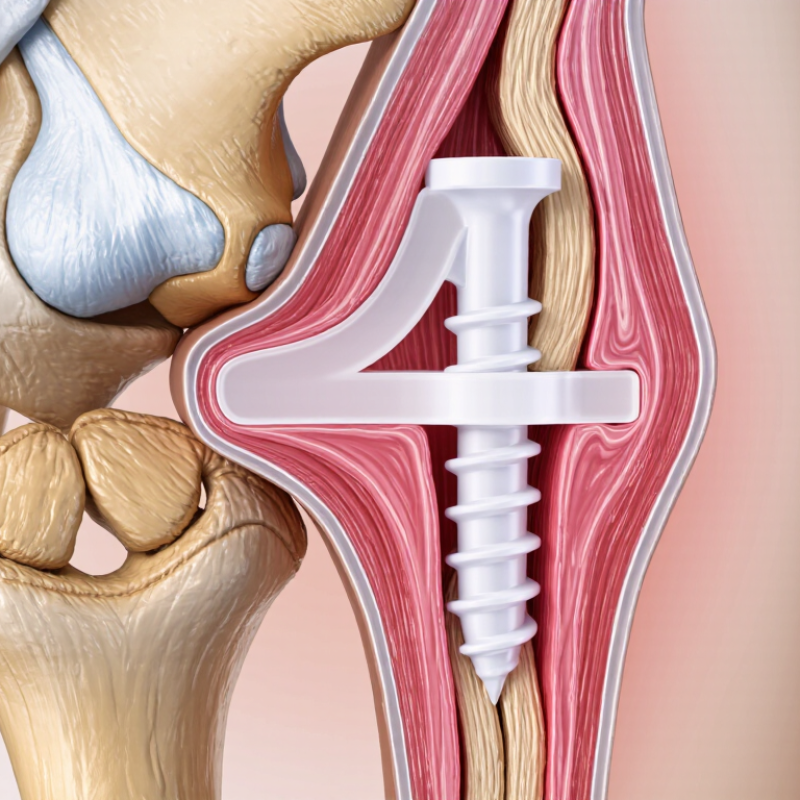
A PEEK interference screw is a non-absorbable implant used to secure a tendon or ligament graft inside a prepared bone tunnel. Its threads engage the tunnel wall and press the graft against surrounding bone. This creates fixation through compression, rather than relying on a plate or external hardware. The screw’s design includes a central core, thread depth and pitch, and often a tapered tip. These details affect insertion and how force is distributed. Some models are cannulated for guidewire placement; others are solid. Small differences matter.
PEEK, or polyether ether ketone, is a strong, radiolucent polymer. Kurtz and Devine’s peer-reviewed review in Biomaterials (2007) reports typical PEEK elastic modulus near 3.6 GPa and tensile strength around 90–100 MPa. These values help explain its use in load-bearing implants, but they do not predict how one screw performs in every tunnel or graft. The material is visible less clearly on standard X-rays than metal, which can aid assessment of surrounding bone. Still, radiolucent does not mean invisible in every imaging method. Screw diameter, tunnel fit, bone quality, and insertion technique all influence fixation. The design is not the whole story.
A PEEK interference screw secures a soft-tissue graft by pressing it against the wall of a prepared bone tunnel. As the screw advances, its threads create compression and friction that resist graft slippage. The surgeon’s tunnel placement, screw size, insertion angle, and bone quality all matter. The screw is only one part of the fixation.
Published material-property tables for unfilled PEEK commonly report tensile strength around 90–100 MPa under ASTM D638 testing. That figure describes the material, not the pullout strength of a screw-and-graft construct. Construct performance varies with screw geometry, graft type, and bone density. PEEK is radiolucent, so it creates less imaging artifact than metal; however, the screw itself may be harder to see on standard X-rays. A strong material number does not guarantee a healed graft.
Tips: Match screw diameter to the tunnel and graft, and avoid forcing insertion if resistance rises sharply. Check fixation and graft tension during surgery. Small details matter.
The trade-off deserves attention: PEEK remains in the body rather than gradually resorbing. Surgeons should weigh that feature against the patient’s anatomy, imaging needs, and rehabilitation plan.
A PEEK interference screw helps secure a graft by pressing it against the wall of a prepared bone tunnel. Its material properties influence how reliably that compression is maintained. PEEK is a strong, dimensionally stable polymer used in load-bearing implants. With suitable design and placement, its threads engage bone while the screw supports graft contact during early healing. That matters. Unlike metal, PEEK is radiolucent and generally creates less artifact on X-rays and CT scans. Clinicians may assess tunnel position and surrounding bone more clearly, although the screw itself can be less visible.
PEEK does not dissolve as the graft heals, and its shape can provide lasting mechanical support. However, it does not inherently promote bone growth. Fixation still depends on screw geometry, graft fit, bone quality, and surgical technique. A close fit is useful, but excessive insertion force may damage the graft or bone. Results vary. The material is one part of the fixation system, not a guarantee of healing.
Why Choose a PEEK Interference Screw?
Common Uses in Ligament Reconstruction
In ligament reconstruction, an interference screw helps secure a graft inside a drilled bone tunnel. This use is especially common in anterior cruciate ligament (ACL) surgery. The screw presses the graft against the tunnel wall, providing fixation while healing progresses. Surgeons may use this approach with hamstring tendon or bone-patellar tendon-bone grafts, depending on the reconstruction plan.
PEEK screws are one option for this fixation. PEEK is radiolucent, so it generally creates less imaging obstruction than metal hardware. That can help clinicians assess the surrounding bone and tunnels on follow-up images, though imaging methods and screw designs vary. Small detail, important. A screw’s material does not determine the whole result.
The right fixation method depends on graft type, tunnel placement, bone quality, and surgical technique. Interference screws may also be considered in other ligament procedures, but their role is not identical across operations. The choice deserves careful thought. PEEK fixation has practical advantages, yet it cannot compensate for poor positioning or replace an individualized surgical plan.
PEEK interference screws are used to secure tendon grafts in ligament reconstruction, especially in procedures such as ACL and PCL reconstruction. Their radiolucency can make postoperative imaging easier to interpret.
Material context: Approximate elastic modulus values are shown in gigapascals. Typical values vary with material grade, test method, and—in bone—the direction of measurement. This chart compares material properties; it does not predict clinical outcomes.
Choosing a PEEK interference screw starts with the graft, tunnel, and fixation plan—not the material alone. Kurtz and Devine’s 2007 Biomaterials review places PEEK’s elastic modulus near 3.6 GPa. Cortical bone is roughly 14–20 GPa in the same review. That difference matters. But modulus alone cannot predict fixation strength; screw geometry, insertion torque, bone quality, and graft type also influence performance.
Consider imaging, too. PEEK generally creates less radiographic artifact than metal, but the screw may be difficult to see on routine X-rays. Check whether the specific design includes a marker, and confirm how the surgeon will assess tunnel position and healing. Match screw diameter and length to the tunnel and graft, rather than assuming a standard size fits every case. Published material data describe the polymer, not the result in an individual knee. A careful choice still depends on surgical technique and patient factors. This is not a perfect rule.
