
Click here to browse our On The Mend Portfolio!
Alzheimer’s disease can begin changing the brain years before memory problems become obvious. Biomarkers help clinicians look for those changes more directly. They include signs of amyloid and tau proteins, as well as measures of brain injury. These clues can come from cerebrospinal fluid, brain imaging, or newer blood tests. Each method has different strengths, costs, and limitations.
In the 2018 NIA-AA Research Framework, Alzheimer’s researcher Clifford R. Jack Jr. and colleagues wrote: “Alzheimer’s disease is defined by its underlying pathologic processes that can be documented by specific biomarkers.” This idea helps explain why an Alzheimer Disease Biomarker may support earlier, more precise assessment than symptoms alone. A scan showing amyloid, for example, can add useful evidence when a clinician evaluates a person’s history and cognitive tests. It does not, by itself, explain every memory complaint or predict exactly what will happen next.
Biomarkers can also help distinguish Alzheimer’s biology from other causes of cognitive change and guide eligibility for certain treatments. Yet interpretation requires care. Results must be considered alongside age, symptoms, medical history, and test accuracy. Some blood tests are promising, but availability and clinical use continue to evolve. The picture is not perfect. A biomarker can clarify part of the story, while leaving important questions open. That uncertainty matters, and it is a reason diagnosis should remain a careful clinical process rather than a single-test decision.
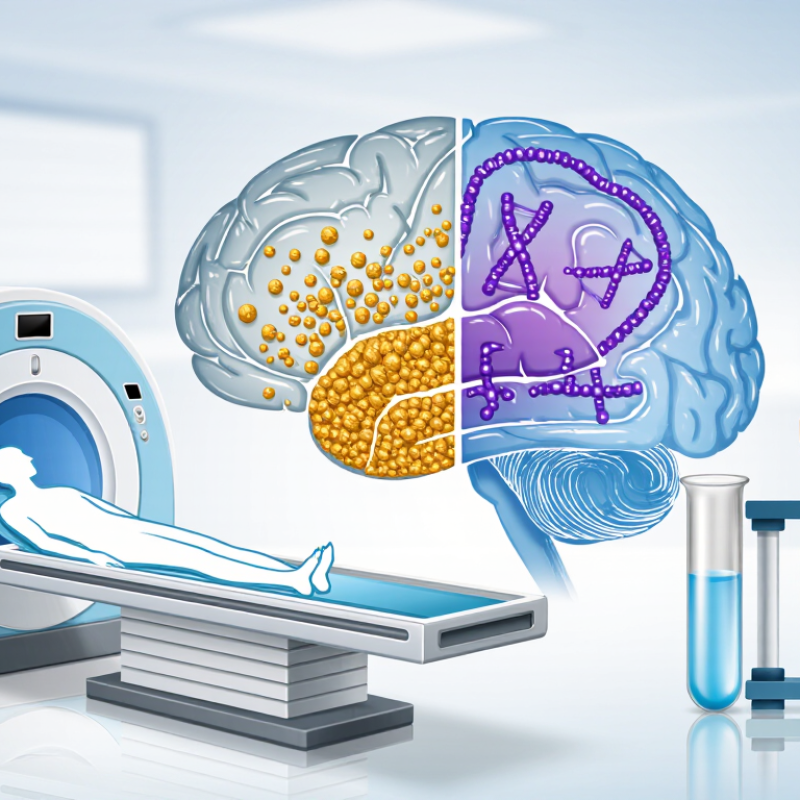
Alzheimer’s biomarkers are measurable clues about disease biology, not direct measures of memory or daily independence. They can indicate amyloid-beta buildup, abnormal tau, or nerve-cell injury. These changes may be detected before clear symptoms appear, but a positive result alone does not establish how a person functions.
Amyloid and tau can be assessed through cerebrospinal fluid, collected by lumbar puncture, or through brain imaging. PET scans show where amyloid or tau has accumulated; MRI can reveal brain structure and shrinkage, which are less specific to Alzheimer’s. Blood tests measure proteins such as phosphorylated tau, which can reflect changes linked to Alzheimer’s pathology. The signal is useful, but it is not the whole picture.
A 2024 JAMA study of 1,213 patients reported about 90% diagnostic accuracy for a combined blood-biomarker approach, compared with 73% for specialist clinical assessment. That result came from a particular study population, not every clinic or patient. Biomarkers still need interpretation alongside symptoms, medical history, and other tests. A result can be unsettling. It may also be ambiguous. Age, other illnesses, and test thresholds can affect interpretation, so clinicians should explain what a result can—and cannot—say.
Why Are Alzheimer Biomarkers Important for Diagnosis?
Main Types of Biomarkers Used in Diagnosis
Alzheimer’s biomarkers are measurable clues to brain changes, often before symptoms clearly identify their cause. The main categories track amyloid, tau, and neurodegeneration, known as the AT(N) framework. Amyloid PET scans show plaque patterns, while cerebrospinal fluid tests measure amyloid-beta and related proteins. These tests can support biological evidence of Alzheimer’s disease, but results need clinical interpretation.
Tau biomarkers include tau PET imaging and spinal-fluid measures such as phosphorylated tau. They help assess disease-related changes, though availability and interpretation vary. MRI can reveal brain shrinkage, and FDG-PET can show altered glucose use. These are useful signs of neurodegeneration, but neither is specific to Alzheimer’s. Blood tests are a less invasive option; their role depends on the test and clinical setting. The boundary is not always neat. The 2018 NIA-AA AT(N) framework organizes these biomarker groups, while the Alzheimer’s Association’s 2024 Facts and Figures estimated 6.9 million Americans aged 65 and older were living with Alzheimer’s. That scale makes careful assessment matter. Biomarkers can strengthen diagnosis, but they do not replace a medical history, cognitive evaluation, or consideration of other causes.
| Biomarker Type | Sample or Imaging Test | What It Measures | Diagnostic Contribution | Important Considerations |
|---|---|---|---|---|
| Amyloid-beta (Aβ) in cerebrospinal fluid | Lumbar puncture; commonly assessed as Aβ42 or the Aβ42/Aβ40 ratio | Low CSF Aβ42, especially a reduced Aβ42/Aβ40 ratio, is associated with amyloid plaque accumulation in the brain. | Can provide evidence of Alzheimer-related amyloid pathology and help clarify the cause of cognitive symptoms. | Requires an invasive lumbar puncture. Results should be interpreted using the laboratory’s validated methods and alongside the clinical assessment. |
| Amyloid PET | Positron emission tomography (PET) brain scan using an amyloid-targeting tracer | Detects the distribution and presence of significant amyloid plaque deposits in the brain. | Can help determine whether brain amyloid is present when the diagnosis is uncertain or when confirmation of amyloid pathology is needed. | A positive scan does not by itself establish that amyloid is the cause of a person’s symptoms. It involves radiation exposure and may not be available in all settings. |
| Phosphorylated tau (p-tau) in CSF | Lumbar puncture; assays may measure forms such as p-tau181 or p-tau217 | Measures abnormal tau-related changes associated with Alzheimer disease. | Supports assessment of Alzheimer-related biology and can be interpreted together with CSF amyloid measures. | Test performance and reference ranges can vary by assay. Results are not interpreted in isolation. |
| Plasma phosphorylated tau | Blood test; available assays measure specific forms such as p-tau217 or p-tau181 | Measures tau-related proteins in blood that are associated with Alzheimer pathology. | Offers a less invasive way to support evaluation and may help identify people who need further testing. | Clinical use depends on the specific test, validation, and care setting. A blood result may need confirmation with CSF or PET testing, particularly when results are unclear or do not match the clinical picture. |
| Tau PET | PET brain scan using a tau-targeting tracer | Shows the distribution of aggregated tau deposits in the brain. | May help characterize the pattern and extent of tau pathology in selected diagnostic or specialist evaluations. | Availability and clinical use are more limited than for some other tests. Findings must be considered with symptoms and other test results. |
| Structural MRI | Magnetic resonance imaging of the brain | Assesses brain structure, including patterns of volume loss, and can identify other structural conditions. | Helps evaluate possible alternative or contributing causes of cognitive impairment and may show patterns of atrophy that support the clinical assessment. | Atrophy is not specific to Alzheimer disease and can occur with aging and other neurological conditions. MRI does not directly detect amyloid or tau pathology. |
| FDG-PET | PET scan measuring brain glucose use | Measures regional patterns of glucose metabolism, which reflect aspects of brain activity. | Can support differential diagnosis by showing patterns of reduced metabolism that may be associated with different types of dementia. | It is an indirect and non-specific measure; findings are interpreted with the history, examination, and other investigations. |
Why biomarkers matter: They can provide biological evidence that supports diagnosis, help distinguish Alzheimer-related changes from other causes of cognitive impairment, and inform further evaluation. No single biomarker replaces a full clinical assessment; test selection and interpretation should be guided by a qualified healthcare professional.
Alzheimer’s symptoms can overlap with those of other conditions, including sleep disorders, depression, or medication side effects. Biomarkers can help clinicians look for biological changes linked to Alzheimer’s disease, rather than relying on memory tests alone. These may include amyloid or tau signals in cerebrospinal fluid, brain scans, or certain blood tests. Each test offers a different kind of evidence.
That evidence can improve diagnostic accuracy, but it is not a diagnosis by itself. A clinician considers test results alongside a person’s symptoms, medical history, cognitive assessments, and daily functioning. For example, a scan may show amyloid buildup, while a careful interview clarifies whether memory changes are affecting familiar routines. Test availability and interpretation can vary, and some blood tests are still being evaluated for different clinical uses. Biology matters. So does context. Biomarkers may help reduce uncertainty, but they cannot always explain every symptom or predict exactly how someone’s condition will change.
Tips: Ask what a proposed biomarker test can—and cannot—show. Discuss how the result might affect care decisions, and whether follow-up testing is needed. Bring a list of symptoms and medications to the appointment. One result is only part of the picture.
Why Are Alzheimer Biomarkers Important for Diagnosis?
The Role of Biomarkers in Early Detection
Alzheimer’s-related brain changes can begin years before memory problems become obvious. Biomarkers—such as amyloid and tau signals measured through brain scans, spinal fluid, or blood—can help detect these changes earlier. That matters when a person is repeatedly losing their way on a familiar walk or asking the same question within minutes. The Alzheimer’s Association’s 2024 Facts and Figures report estimated that 6.9 million Americans aged 65 and older were living with Alzheimer’s dementia. Early, careful assessment is important.
A biomarker result is not a diagnosis by itself. Clinicians interpret it alongside symptoms, medical history, cognitive testing, and other possible causes. Some people have biomarker changes without clear daily impairment, and a result cannot reliably say when symptoms may develop. New blood tests are expanding access, but their accuracy and appropriate use depend on the test and clinical setting. That gap between a biological signal and a person’s lived experience deserves humility. Earlier testing can inform discussions and next steps, but it does not make every uncertainty disappear.
Tips: Note changes with dates and specific examples, such as missed appointments or repeated questions. Bring the list to a clinician. Ask what a proposed biomarker test can—and cannot—show. A small detail may help.
Alzheimer biomarkers can reveal changes linked to the disease, but a result is not a complete diagnosis. A scan may show amyloid buildup, while spinal fluid or blood tests can measure related proteins. Each method has limits. Some tests are still being evaluated, and accuracy can vary across patients and settings.
A positive result does not prove that memory problems come from Alzheimer’s. Some people show biomarker changes before noticeable symptoms, while others have changes alongside different health conditions. Age, medications, sleep, and other illnesses can affect the clinical picture. Context matters. Clinicians consider test results alongside memory assessments, medical history, and daily functioning. A blood test may be useful, but it may not replace more established testing in every situation.
Testing also brings practical and personal questions. A scan can involve radiation or long waits, depending on the method; a spinal fluid test requires a needle procedure. Cost and access vary, too. Patients should ask what a result could change about care, and whether follow-up testing may be needed. Not every uncertainty can be removed. I would be cautious about treating one number as the whole story.
Biomarkers can help identify Alzheimer’s-related amyloid and tau pathology, supporting diagnosis alongside symptoms and clinical assessment. Guideline thresholds are not the measured accuracy of every test: results can vary by test and patient population, and false results are possible. A positive result does not by itself explain a person’s symptoms.
Thresholds shown: Alzheimer’s Association clinical practice guideline for blood-based biomarkers in specialized care. Triage use: at least 90% sensitivity and 75% specificity. Confirmatory use as a substitute for CSF or PET testing: at least 90% for both.
