
Click here to browse our On The Mend Portfolio!
A Solid State Diode Laser turns electrical energy into a narrow, concentrated beam using semiconductor materials. A tiny chip, metal contacts, and a heat sink may sit together inside a compact module. The phrase can be confusing, though. It may describe a semiconductor laser diode, or be mistaken for a diode-pumped solid-state laser, which uses a diode to energize a separate gain material. They are related technologies, but not identical.
Laser pioneer Theodore Maiman once remarked, “A laser is a solution looking for a problem.” His line captures a useful question: what task should the beam perform? In practice, wavelength, output power, beam quality, and thermal control shape the answer. A laser used for precise measurement has different needs from one used for material processing. Small details matter. A warm housing can affect stability; an unsuitable wavelength can make a system ineffective.
This introduction sets out the basic structure, operating principle, common uses, and selection factors for a Solid State Diode Laser. It also separates diode lasers from diode-pumped solid-state designs, where terminology often gets blurred. That distinction is easy to overlook. Specifications deserve careful reading, and a product label alone may not reveal the full optical design. Engineers should verify operating conditions against manufacturer documentation and test results. Some trade-offs remain; compact size does not guarantee better beam quality or longer service life. The goal is a clear starting point, not a claim that every laser fits every job.
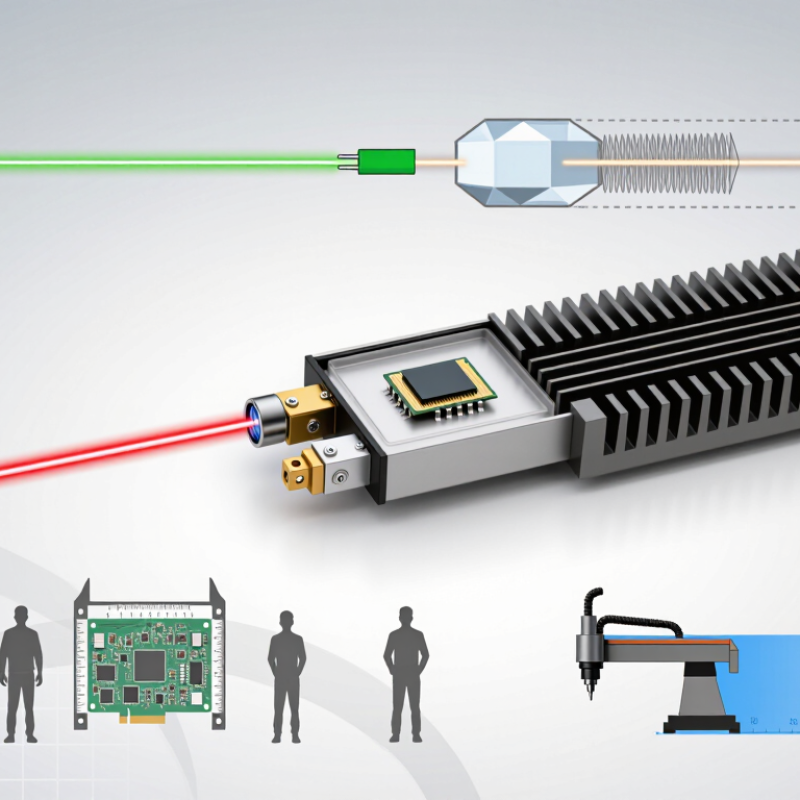
The phrase “solid-state diode laser” can describe a solid-state laser pumped by semiconductor diodes. In common technical usage, the solid-state gain medium is a crystal, glass, or ceramic, while the diodes supply pump light. A laser diode itself is different: its semiconductor material generates the laser beam directly. The distinction is easy to miss.
In a typical design, diode light enters a gain medium such as neodymium-doped crystal. The dopant atoms absorb energy and move into excited states. When returning to lower-energy states, they can emit photons with matching wavelengths and phases. This is stimulated emission. Small details matter. The medium’s composition and temperature affect how efficiently it absorbs pump light and produces output.
Mirrors around the gain medium form an optical resonator. Light reflects back and forth, encouraging further emission; a partially transmitting mirror releases part of it as the laser beam. The output wavelength depends largely on the gain material, while the resonator and optics help shape the beam. Cooling is important because unused pump energy becomes heat. A warm crystal can shift performance. In practice, the phrase may be used loosely, so checking whether a source means a diode-pumped solid-state laser or a direct-emitting diode helps avoid confusion.
A solid-state diode laser usually means a diode-pumped solid-state laser: a semiconductor diode supplies pump light to a solid gain medium, often a crystal or glass. The diode converts electrical current into light. The gain medium absorbs that light and emits laser energy. Two mirrors form the resonator, sending light back through the medium until a usable beam emerges. Small alignment errors matter; even a slight shift can reduce output.
A power supply regulates current, while control electronics monitor temperature and output. Heat sinks or cooling systems carry away waste heat, protecting the diode and stabilizing the wavelength. SPIE’s 2024 Global Industry Report estimated photonics-enabled products and services generated about US$2.2 trillion in 2022. That broad industry figure is not a laser performance benchmark, but it shows why dependable optical components matter across manufacturing and measurement. One caveat: “solid-state diode laser” is used loosely, so check whether a specification describes a direct diode laser or a diode-pumped crystal laser.
Tips: Keep the optical path clean, and check cooling before troubleshooting beam fluctuations. Compare output power at the operating temperature, not just the room-temperature rating. A neat specification sheet can still leave practical questions unanswered.
| Component | Typical Example | Primary Function | Key Operating Detail |
|---|---|---|---|
| Diode pump source | Semiconductor laser diode | Provides optical energy to excite ions in the solid-state gain medium. | Its wavelength is selected to overlap an absorption band of the gain medium. Around 808 nm is commonly used to pump Nd:YAG, though other pump wavelengths and materials are also used. |
| Gain medium | Neodymium-doped yttrium aluminum garnet (Nd:YAG) crystal | Amplifies light through stimulated emission after absorbing pump energy. | Nd:YAG commonly produces infrared laser light near 1064 nm. Other gain media can produce different wavelengths and operating characteristics. |
| Laser resonator | Optical cavity formed by two mirrors | Reflects light through the gain medium repeatedly, allowing amplification to build. | The cavity’s alignment and optical properties affect threshold, output, and beam characteristics. |
| High-reflector mirror | Mirror highly reflective at the laser wavelength | Returns most of the resonating light through the gain medium. | It is commonly designed to transmit the pump wavelength while reflecting the laser wavelength, depending on the laser configuration. |
| Output coupler | Partially transmitting cavity mirror | Allows a controlled portion of the circulating laser light to leave the cavity as the output beam. | Its reflectivity and transmission are chosen to balance output extraction with the gain available in the medium. |
| Pump-coupling optics | Lenses or reflective optics | Direct and focus pump light into the gain medium. | Efficient coupling helps reduce wasted pump energy and can improve output stability. |
| Thermal management | Heat sink, conductive mount, or cooling system | Removes heat generated in the diode and gain medium. | Temperature affects diode wavelength, gain-medium performance, and mechanical alignment; adequate cooling helps maintain stable operation. |
| Diode current driver | Regulated laser-diode power supply | Controls the electrical current supplied to the pump diode. | Low-noise, controlled current helps limit unwanted power fluctuations and protects the diode from excessive current. |
| Optional frequency-conversion crystal | Nonlinear crystal for second-harmonic generation | Converts the fundamental laser wavelength to a shorter wavelength. | For example, frequency-doubling 1064 nm output can produce light near 532 nm when the crystal and cavity are appropriately configured. |
A diode-pumped solid-state laser uses a semiconductor diode as the pump source and a solid material as the gain medium. The exact components and wavelengths vary with the laser design.
How Electrical Energy Becomes Laser Light
A solid-state diode laser begins with a semiconductor junction, not a lamp filament. When voltage drives current through it, electrons and holes meet inside a thin active region. Their recombination releases energy as photons. The process starts small. Reflective surfaces around the region send some photons back through it, encouraging stimulated emission. Matching photons build up and leave through a partially transmitting surface as a narrow beam. This is how electrical input becomes organized light.
The details matter. The diode’s material sets the light’s wavelength, while current and temperature affect its output. A small rise in heat can shift performance, so many systems use heat sinks or temperature controls. Not all input becomes light; some becomes waste heat.
Easy to overlook.
In practical use, a laser module may feel warm even when its beam looks steady. Stable power and careful optical alignment also affect reliability. The explanation sounds neat on paper, but real devices have losses and tolerances. That gap deserves attention when comparing efficiency under different operating conditions.
Common solid-state diode lasers use a semiconductor junction to convert electrical current into light. Edge-emitting diodes send light from the chip’s side and can produce a narrow, directional beam. They are often used when efficient output and compact size matter. Vertical-cavity surface-emitting lasers, or VCSELs, emit perpendicular to the chip surface. Their circular beams and easy array integration suit sensing and short-range optical links. The terminology can be confusing: “diode laser” describes the light source, while “solid-state laser” may also refer to a separate crystal or glass laser pumped by diodes.
Operating behavior depends on the device design. Below its threshold current, a diode mainly produces weak, broad light; above threshold, coherent output rises quickly. Small changes matter. Drive current, chip temperature, and cooling all affect output power and wavelength. For example, a warm heatsink can shift the emission wavelength and reduce efficiency. High-power bars combine many emitters, while stacked arrays increase output further, but they also produce more heat and less uniform beams. Check the specified operating current, temperature range, and beam shape for the actual application. Real devices vary, and a neat datasheet curve does not capture every setup.
Semiconductor diode lasers produce light when electrical current passes through a semiconductor junction. Their wavelength depends on the active material and device design. The chart shows representative wavelengths for common examples; actual operating ranges vary.
Operating note: Edge-emitting lasers and VCSELs are commonly used in visible and near-infrared applications. Distributed-feedback (DFB) lasers provide narrow-linewidth output for telecommunications, while quantum cascade lasers (QCLs) emit in the mid-infrared using intersubband transitions.
A solid-state diode laser can mean a semiconductor laser, or a crystal laser pumped by diodes. The distinction matters. In a semiconductor device, electrical current produces light directly; in a diode-pumped solid-state system, diodes energize a separate crystal. Both appear in alignment, sensing, medical equipment, and material processing, but their beam quality and operating needs differ.
Applications depend on wavelength, output power, pulse behavior, and beam shape—not power alone. Grand View Research estimated the global laser diode market at about $7.1 billion in 2023, while Fortune Business Insights valued the broader laser market at $20.54 billion that year. These estimates cover different product categories, so they should not be compared as equivalent measures.
In practice, check whether the wavelength suits the material or detector, and whether the beam remains stable as the unit warms. Heat matters. A compact enclosure can trap it. Match the driver, cooling method, and duty cycle to the intended workload, then verify performance under real operating conditions. One easy oversight: a tidy specification sheet cannot predict dust, vibration, or awkward mounting angles. Keep those details in the test plan.
